One Industry, Many Rulebooks
How do fashion multinational enterprises adapt their global value chains and sourcing strategies in response to international regulatory divergence?
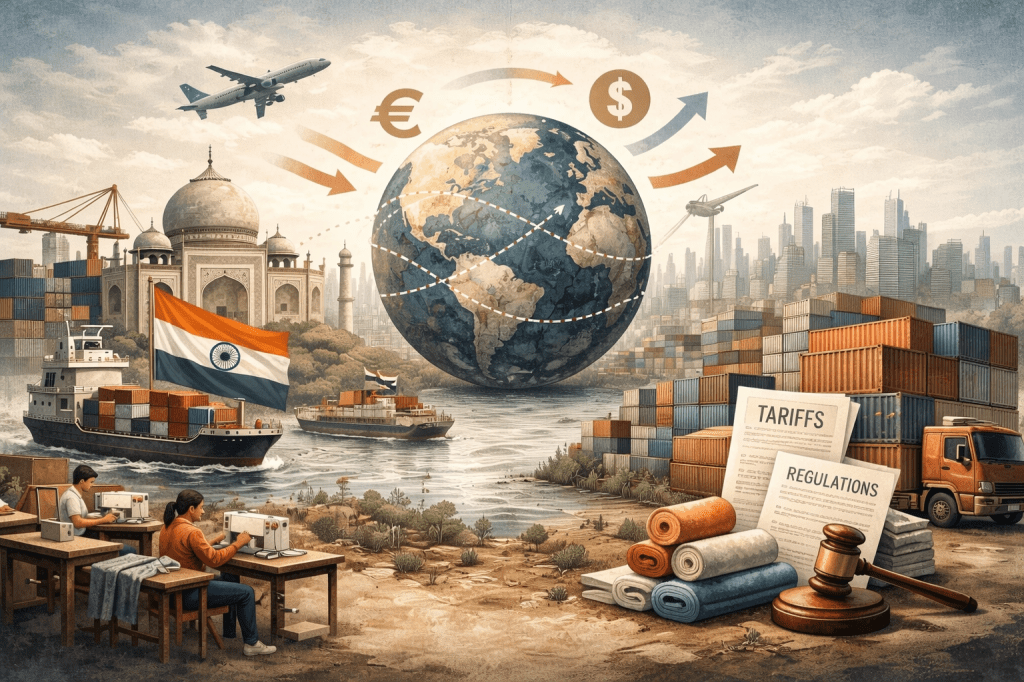
Global fashion supply chains exemplify the depth of modern globalization. From textile production to final assembly, a single garment often crosses multiple borders before reaching consumers. While production networks are globally integrated, the regulatory environments governing them are not. When operating outside their home markets, fashion multinationals must adapt sourcing and production decisions according to global divergence in trade rules, labor standards, and enforcement regimes.
In the fashion industry, regulatory divergence refers to the coexistence of differing trade policies, labor and environmental regulations, and compliance standards within a single global value chain. Regulatory differences do not merely raise costs; they complicate coordination across borders and force multinational enterprises (MNEs) to weigh traditional comparative advantage against institutional constraints. As value chains become more complex, firms must prioritize transparency to prevent compliance failures that could disrupt operations and erode profitability.
From India to the Rest of the World: Changing Trade Policies and Agreements
These regulatory dynamics become more visible when firms decide where to source production for export into specific end markets. The finalization of the India-EU Free Trade Agreement (FTA) in January 2026 represents a clear example of divergent trade regimes reshaping sourcing incentives. By granting zero-duty access for textiles and apparel, the FTA opens the EU’s $263.5 billion import market to Indian exporters. This is projected to increase India’s year-on-year apparel exports to the EU by 20-25%, a sharp rise from the previous 3.01% growth rate (Economic Times, 2026).
The FTA’s zero-duty access restores India’s cost competitiveness relative to other sourcing countries by offsetting regulatory disadvantages imposed by other countries. India’s suspension from the Generalized System of Preferences (GSP) with the US in 2019, and more recently with the EU, exposed exporters to higher tariffs affecting approximately $5.6 billion, or 12%, of India’s total exports to the US (BBC, 2019). This regulatory shift — driven by US efforts to address trade imbalances — incentivized fashion multinationals to reevaluate sourcing strategies, diverting production toward countries with favorable trade arrangements, namely China.
The 2026 India-EU FTA fuels a strategic pivot toward the EU as a more stable, predictable export destination amid rising tariffs and tightening trade policies in the US market. Indian manufactures can rebalance production capacity, expand to higher-value buyers, and reduce dependence on a single market. Previously, India’s garment sector had lagged behind competitors like Bangladesh, which benefited from duty-free access to the EU. With Bangladeshi apparel up to 10% cheaper for European retailers operating on thin margins, sourcing started rapidly transitioning away from India. Bangladesh’s government further leveraged this regulatory divergence by investing in infrastructure and subsidizing manufacturers, reinforcing its competitive position within global apparel value chains relative to India.
Firm-Specific Responses to Regulatory Divergence
Regulations in the apparel industry, both within a country as well as its global dynamics, are constantly evolving. In response to persistent regulatory uncertainty, fashion multinationals rarely pursue a single optimal sourcing location. For example, Inditex, the multinational fashion group of several popular brands, have adopted structured sourcing portfolios that prioritize countries with preferential trade access and regulatory alignment with end markets.

Hence, Inditex occupies significant production capacity in Turkey and Eastern Europe; allowing the firm to manage regulatory compliance, shorten lead times, and reduce exposure to tariff volatility by maintaining proximity to its key European end markets. Inditex’s approach reflects how regulatory divergence — rather than just cost minimization alone — is a critical consideration that shapes sourcing decisions when fashion MNEs operate outside their home markets.
The fashion industry reveals how global value chain decisions are becoming increasingly shaped by regulation rather than cost efficiency alone. As trade rules and operational standards diverge across markets, strategic adaptability has become an essential driver of competitive advantage.
 Global Value Chains in Fashion